
Office Building Roofing in Bozeman, MT
Office Building Roofing in Bozeman and the Gallatin Valley
Picture a two-story office building with a flat roof and a row of rooftop units along the back wall. By April the snow is gone from the field, but a gray ridge of old ice still sits at the low corner, and the ceiling tile beneath it carries a faint brown ring. That ring is the building talking. Each Bozeman, MT winter drops around 91 inches of snow, and an office roof has to carry it, shed it and stay quiet over people at their desks. Where does the stain sit in relation to the units?
We inspect, repair and replace office building roofs across the Gallatin Valley, and we plan around tenants before we order material.

Which office buildings are we talking about?
Midtown's urban renewal district, running along North 7th Avenue, targets infill, housing and retail, and Downtown Bozeman holds older commercial buildings. Optics, laser, software and biotech firms take office and flex space of every age. Which roof sits on a given building is settled by walking it.
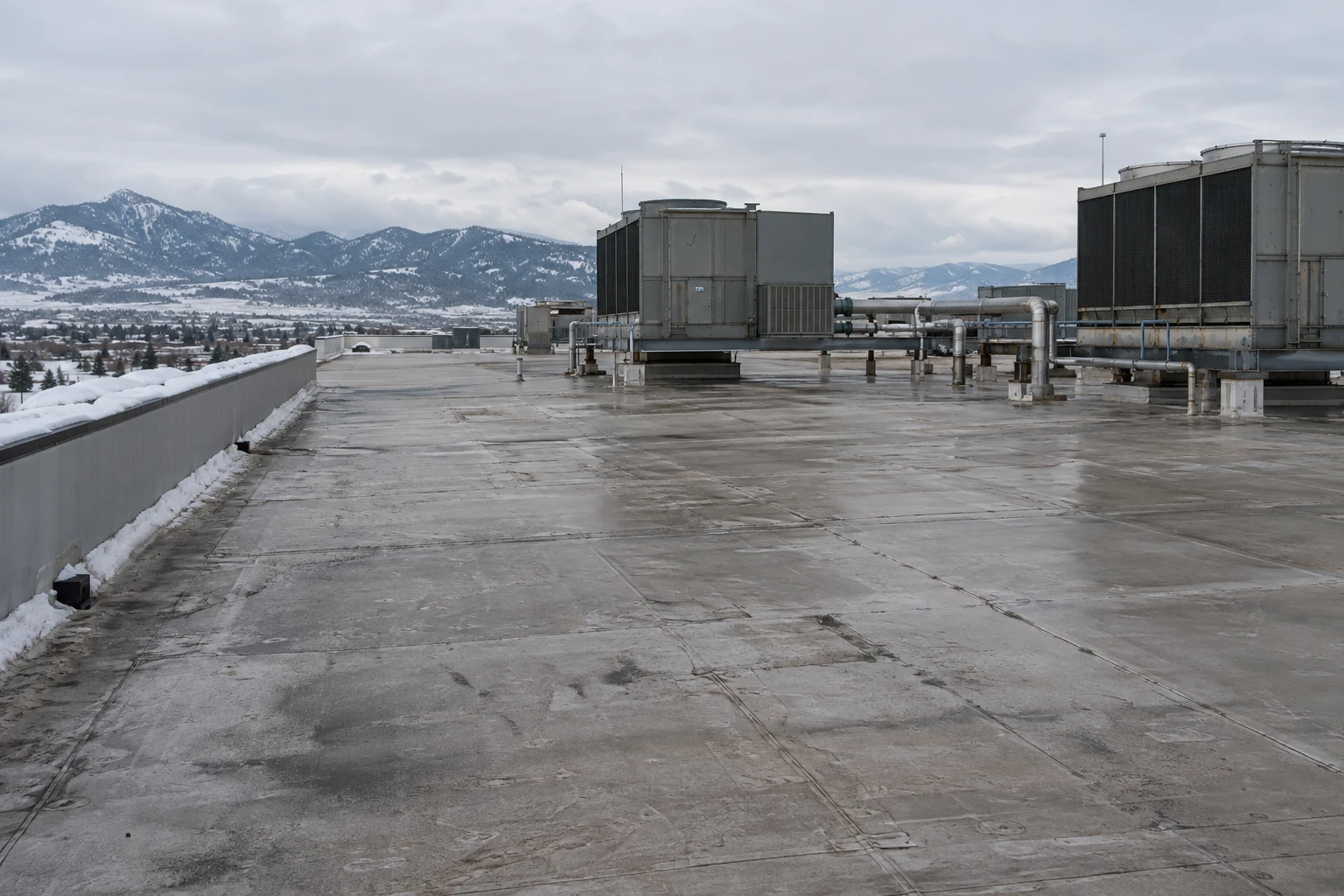
Office roofs tend to be small to mid-size, low-slope and crowded with mechanical equipment. Many are shared by several tenants, so a leak can start in one suite and drip in another. A plan that maps each suite to its roof section saves argument later, and we build that plan on the first walk.
New infill buildings bring a separate task. A roof installed during construction should be walked at turnover, with drains, seams, curbs and edges checked and a punch list written while the builder is still responsible. Photographs from that walk become the baseline for every later inspection, and they cost very little compared with arguing about a defect two winters later.
What does snow do over an entry?
Snow that slides off a warm roof lands where people walk. Design snow on the ground in Bozeman is 50 psf, and drifts behind parapets and units add to local weight. When the sun hits, meltwater runs to the edge, refreezes and builds a ridge of ice at the eave. A slab of it can let go over a door.
We map the fall zones under each edge, check edge metal and gutters and list the places where snow guards or a re-sloped edge would protect an entry. Scuppers and drains get a flush before the first heavy storm. Over an entry, the safe edge detail is part of the roof spec, not an extra.
Why do rooftop units cause so many leaks?
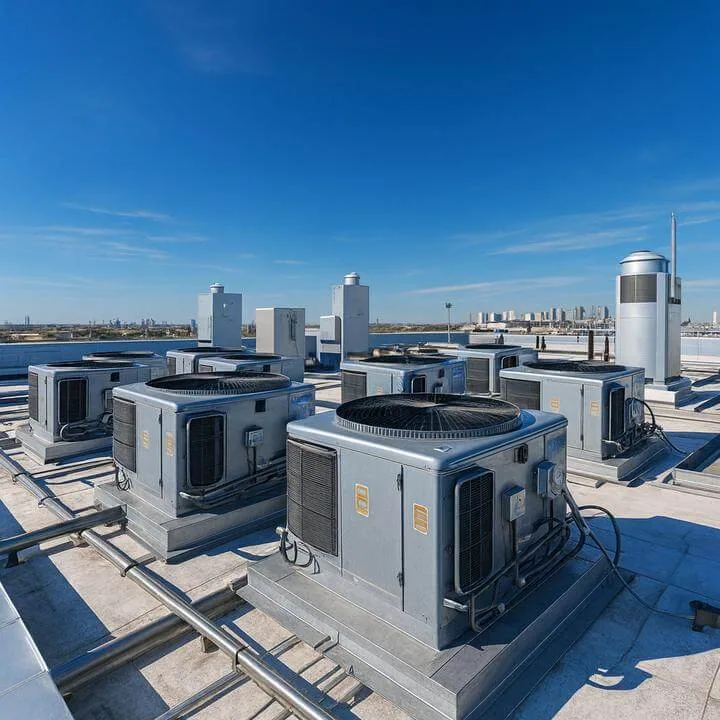
Every unit stands on a curb, and every curb is a flashing detail with a seal that moves with the building. Service technicians walk the same path to the same units, and the membrane along that path wears first. Refrigerant lines, condensate drains and electrical conduit cross the roof at more points than a first glance suggests.
We count units, check each curb and support and photograph every penetration. Walkway pads go along the service path, and abandoned lines are capped or removed. When an old unit is swapped for a new one, a curb adapter or a new flashing is usually needed, and the roofer should be on site before the crane lifts the old unit off.
Condensate lines deserve a note of their own. A drain that discharges onto the membrane in summer becomes a sheet of ice in winter, right where technicians walk. We reroute those lines to a drain or a splash pad and mark the change on the plan. It is a small fix that prevents both a membrane wear spot and a slip hazard.
What do hail and wind do to an office roof?
The June 30, 2010 hailstorm took out dozens of Montana State University windows and ripped apart the Ellen Theatre marquee downtown. Sensors on Triple Tree Road southeast of Bozeman read 65 mph gusts on August 29, 2023. Both events remind owners that the valley weather arrives fast.
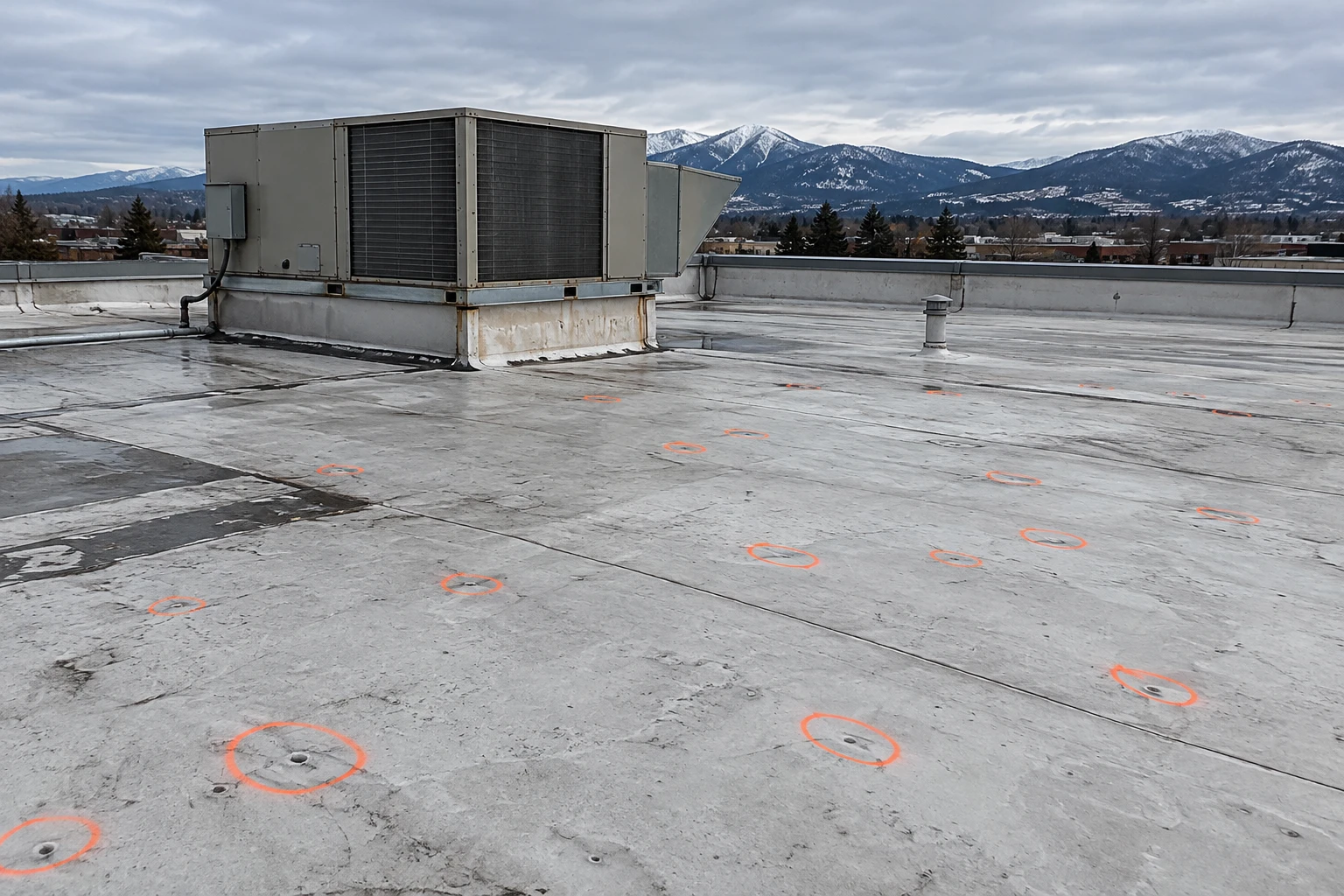
After a storm we walk the roof, flag bruises and check the edges. A hail damage repair record starts with photographs, a scale in each frame and a core cut at the deepest mark. The dated record supports an insurance claim and shows whether the insulation took the blow.
How is the work scheduled around tenants?
Offices are quiet and have set hours, so noise is the main complaint. We schedule loud work, such as tear-off and fastening, for the start of the day or off hours where the lease allows, and we give tenants notice. Air intakes near the work are shielded, and a contact person is named for each floor under the work. Occupied building reroofing sets those terms in the scope.
Staging is the other piece. Parking spaces, loading areas and fire lanes affect where the laydown yard and crane go, and the landlord signs off on the plan. We divide the roof into sections that are dried in the same day, so a sudden storm does not find an open roof over a suite. Parking is the quiet constraint: a crane and a laydown yard take spaces that tenants and visitors use, so the plan names which stalls close, for how many days, and who tells the people who park there, a notice the property manager can send in one email.
Repair, recover or replace?
The roof tells us. A flexible membrane, dry insulation and failures confined to details make a repair candidate. Wet insulation over a wide area, a cracking field membrane or broad hail bruising points to replacement, which costs less per year of life by then. A medical office or a server room in the same building raises the priority of the roof section above it.
We run an infrared survey and cut cores before the decision, and we lay out the options with expected service and cost side by side. Work near Midtown and downtown Bozeman follows the same sequence.
A recover is possible on many office roofs when the insulation is dry and the deck is sound, and it keeps tenants working below with less noise than a full tear-off. We count existing layers first, since a deck can carry only so many, and we show the owner the count with the cores.

Questions About Office Building Roofing
How do I find which tenant's unit is causing a leak?
Trace the stain uphill along the deck, check curbs and seams on the path, and run a controlled water test if needed. The answer goes on the roof plan with a photograph, so repair responsibility is clear.
Can an office roof be replaced in one summer?
Most can, in sections, within the warm, dry window. Book the walk in spring so material is ordered early, and expect a backup date for weather. Larger buildings may phase over two seasons.
What if a rooftop unit needs replacing soon?
Plan the roof work first or together with it. A new roof under an old unit is a waste if the crane will damage it, and a new unit on an old roof can leave a curb that does not match.
Do snow guards belong on an office with a flat roof?
Usually not on the field. They matter on metal edges, sloped sections and canopies over entries. We check the fall zone at each edge and size protection to the real risk.
What documents help when selling an office building?
The roof plan, the last condition report, warranty terms, repair records and recent photographs. A buyer's lender will ask for them, and having them ready shortens the review.