
Johns Manville Roofing Systems in Bozeman, MT
Johns Manville Roofing Systems in Bozeman and the Gallatin Valley
The part of a roof you cannot see is often the part that decides how long the top lasts. Johns Manville supplies commercial roofing in several families, along with the insulation that sits under them, and on a Bozeman, MT roof that insulation takes a beating from cold, moisture and snow weight. A membrane can look sound for years over insulation that has been wet since the second winter. So before we talk about the sheet on top, what is the board underneath it doing, and when did anyone last look?
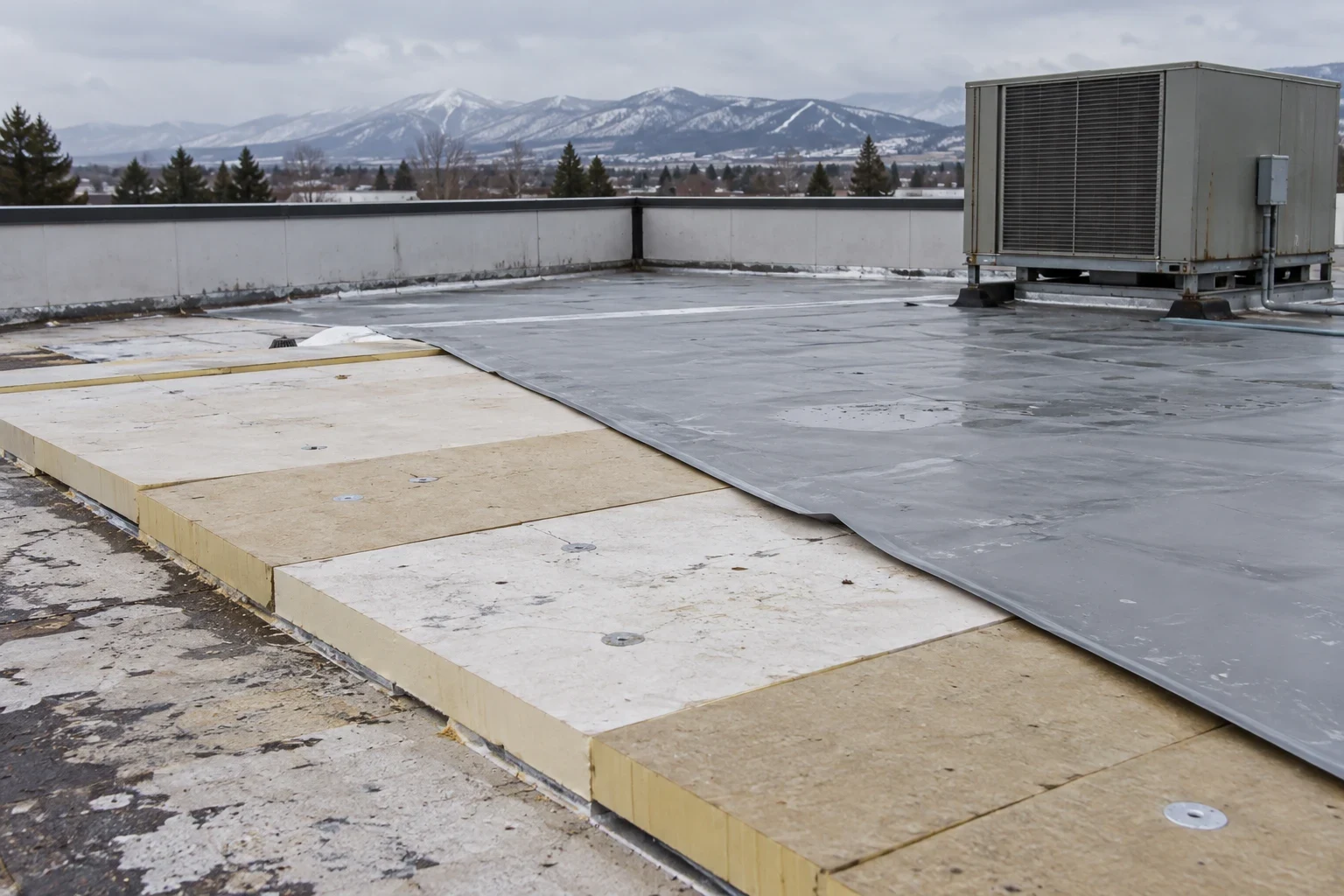
What is under the membrane on a commercial roof?
A typical low-slope assembly stacks several layers. A deck of steel, concrete or wood. A vapor control layer where the building calls for one. One or more layers of rigid insulation, often polyisocyanurate. A cover board in some assemblies. Then the membrane. Each layer has a job, and each can fail on its own: insulation absorbs water, a cover board crumbles, a vapor layer is punctured.
I find out what is there with a core cut. A small circular sample shows each layer and its thickness, and a moisture meter tells me whether any layer holds water. A roof that is wet at the bottom and dry at the top is common after a leak was patched but never dried out. The core is the only reliable way to learn that, and it decides whether a repair, a recover or a replacement is the right move.
Each core hole is patched the same day, with a plug of matching insulation and a membrane patch welded or adhered over it, so the sample never becomes a leak of its own. We mark the location on the roof diagram. Three or four cores on a mid-size roof, taken at the low point, near a curb and in the open field, usually tell the whole story.
Why does cold matter to insulation?
Januarys in Bozeman run near 15 degrees F at night, and the record low is minus 46. Some rigid insulation types lose part of their rated resistance when the temperature falls, so a roof that performs on paper in July works harder in January than the label suggests. Where energy cost matters, the answer is more thickness or a layered, staggered design that cuts heat flow at the joints.
Moisture is the other enemy. Water vapor from inside the building moves toward the cold deck and condenses on the underside, and wet insulation loses much of its value. We check that the vapor layer is continuous, that penetrations are sealed and that edges are closed. In a building that holds humid air, such as a kitchen, a pool or a brewery, the vapor layer is often the first thing to fail, and the first sign is dripping from the ceiling on cold mornings. Those details are where a replacement starts, with roof insulation and cover board specified around them.
What does a cover board do in hail country?
The cover board is the layer between the insulation and the membrane, and it shields the insulation from foot traffic, tool drops and, most of all, hail. Bozeman took a half hour of golf-ball stones on June 30, 2010, with baseball-size ones east of Gallatin Field, and early August 2013 brought gusts of 89 mph and golf-ball hail to Belgrade and the north side.
Without a cover board, a hailstone can crush the insulation below the membrane, leaving a soft spot that cracks the reinforcement and leaks later. With one, the stone is spread across a harder surface. The tradeoff is cost and weight, and the right board depends on the assembly and the membrane. Boards are fastened or adhered to match the wind rating of the system, and joints are staggered from the insulation below so a seam does not run straight through the stack. After a storm, we probe the soft spots, mark them and test for moisture, then record the results for a claim.
How do the layered asphalt systems age differently?
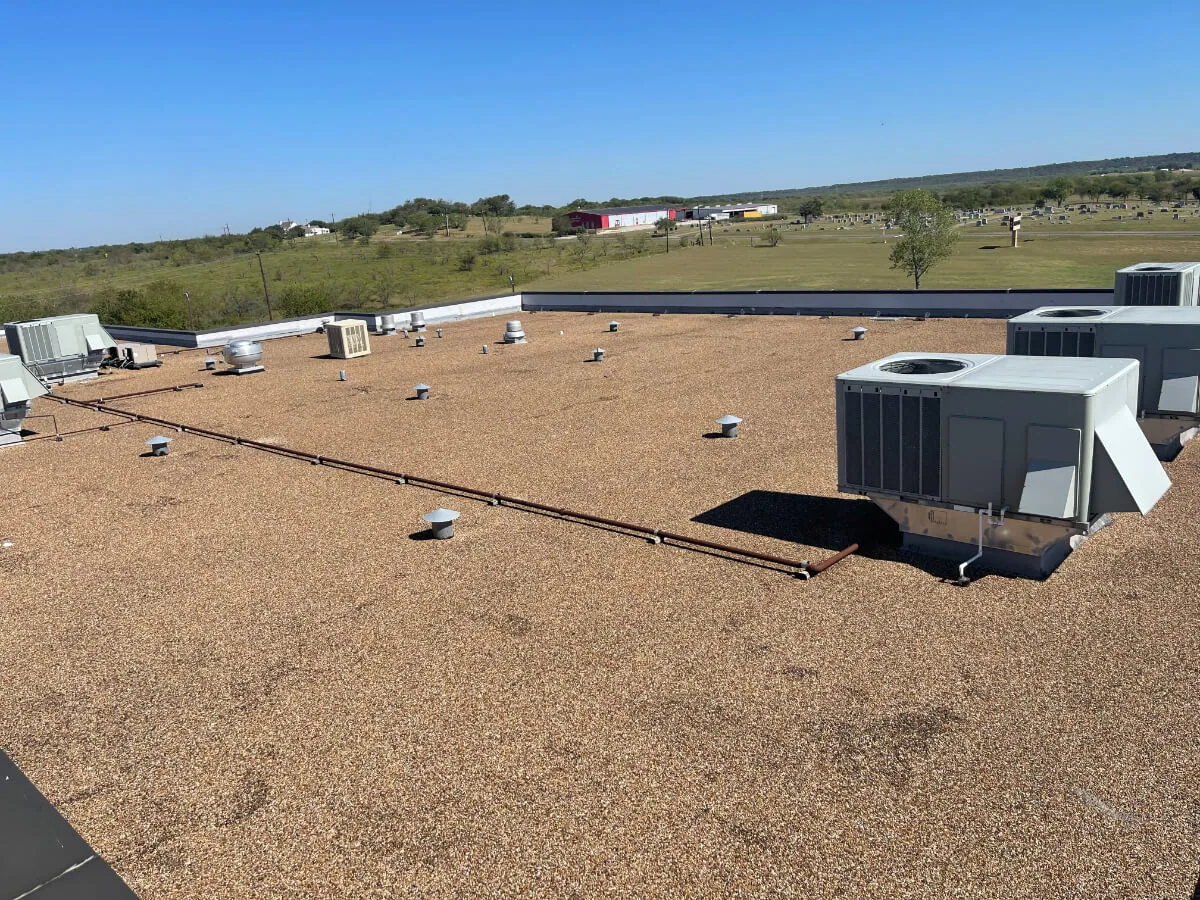
Where the roof is a built-up or modified bitumen system, the layers are plies of felt or reinforced sheet bonded with asphalt, with a surface of gravel, granules or coating. They are heavy and tough, and they tolerate foot traffic well. They also blister if moisture is trapped between plies, and they crack at laps in deep cold.
I look for blisters, splits, bare spots and open laps. A blister that sits over a dry ply is cosmetic. A blister that weeps water is not. The repair depends on the family and the weather: cut and patch, cold-applied flashing, or a new cap sheet over a sound base. A built-up roofing repair and a modified bitumen roofing repair each depend on a moderate, dry window to cure.
Where do these assemblies show up in the valley?
Any low-slope commercial building can carry one. Strip centers and big stores on North 19th Avenue, warehouse and flex buildings near Belgrade and the older masonry buildings of Downtown Bozeman all have roofs where the insulation question is the real one.
For a downtown building, the structure may not carry much extra weight, so adding a heavy insulation stack needs a framing check. For a warehouse, long runs favor larger boards and fewer joints. For a retail roof, the cover board and the walkway pads protect the work from daily wear. In all three cases, the same question comes first: how much of the existing insulation is dry?
What should an owner expect to receive after the work?
A written scope that lists each layer, its thickness and its type. Photographs of the deck, the insulation and the membrane at each stage. The core results. A diagram of drains, curbs and penetrations. And, if the manufacturer has a program for the system, the owner should get the specific requirements in writing from the manufacturer or the installer, since they vary by product.
That record answers later questions about what is under the roof. For several buildings, a roof capital planning approach turns the cores into a budget. Roofs from GAF and Holcim Elevate get the same identification step before any repair.

Questions About Johns Manville Roofing Systems
Our roof has a small leak that was patched twice. Why does it still drip?
The insulation beneath is probably wet, and water travels along it to a new spot. Patching the top does not dry it out. A core cut and a moisture survey show how far the wet area runs, and we cut out the wet insulation and replace it.
Is more insulation worth it at a reroof?
Often, yes. More thickness cuts heating cost and holds the deck warmer. We check the framing, the rooftop curb heights and the ceiling space for condensation risk, then size the assembly to fit them. Tapered boards added at the same time can also fix ponding without a separate project.
Do we need a cover board if no trees overhang the roof?
Hail is the main reason, not trees. A cover board protects the insulation from hail and foot traffic. Without it, a hailstone can crush the board beneath the membrane. We recommend one where hail and traffic are both likely.
Can a damp section of insulation be replaced without redoing the roof?
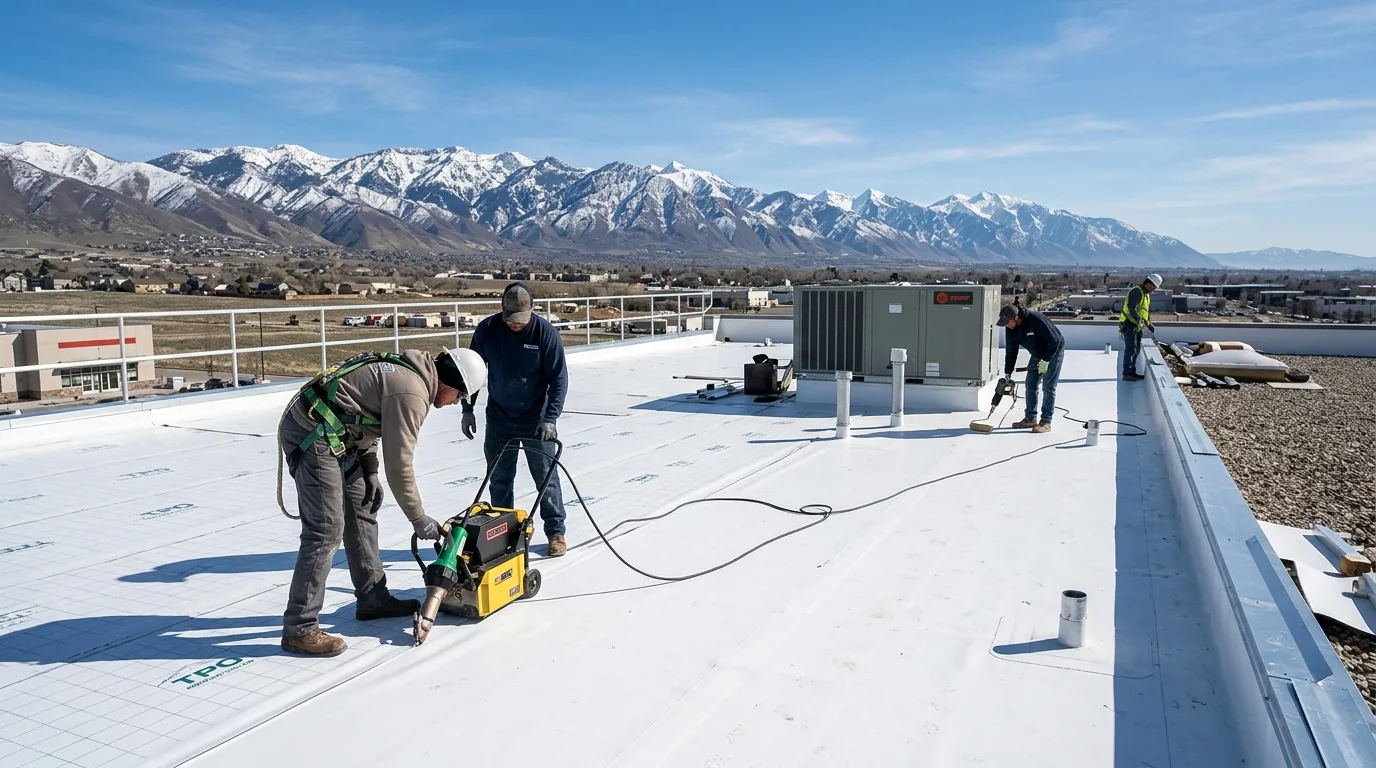
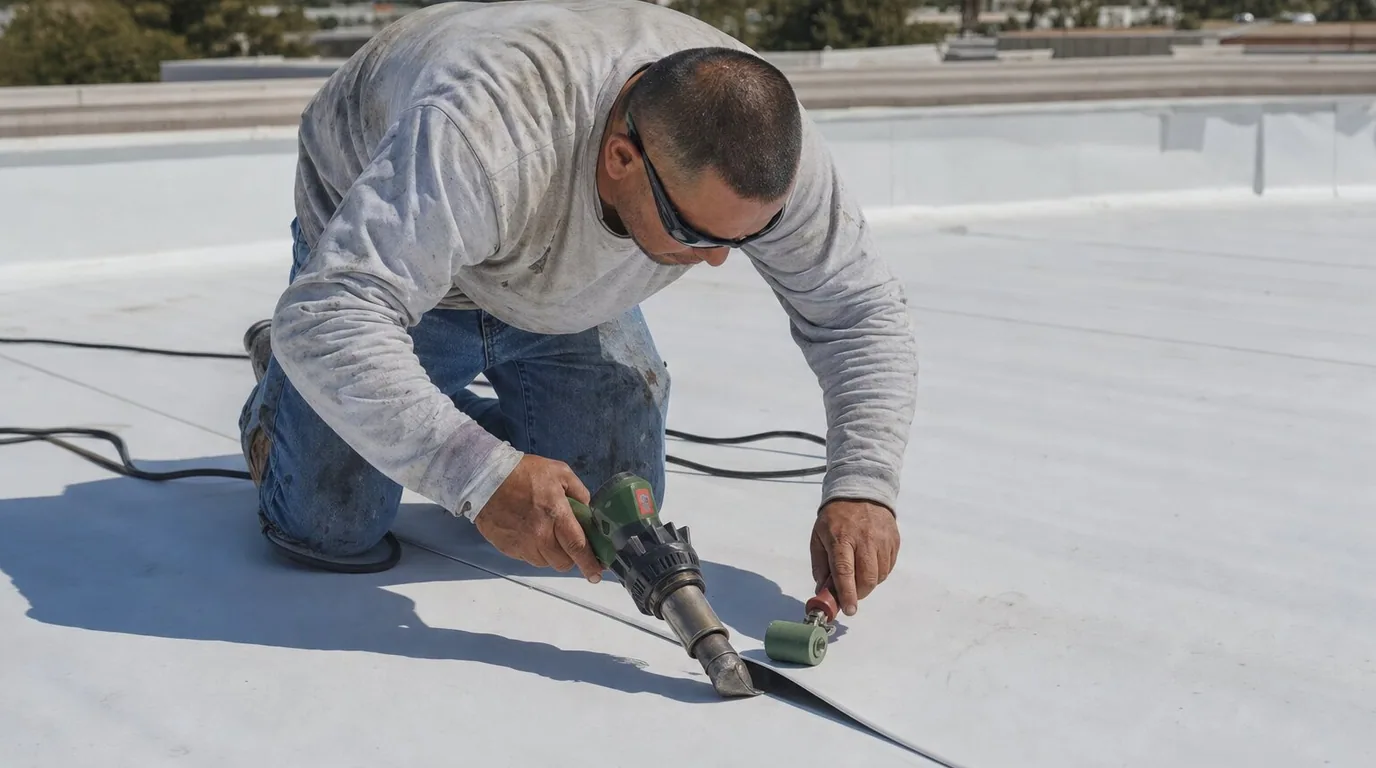
Yes, when it is confined. We cut out the wet section, install dry board and tie in a new membrane. The surrounding roof is checked for moisture so the repair does not hide more of the same. Edges of the repair are lapped over sound membrane, and the patch is welded or adhered the same day so the opening is never left to the weather.