
School Roofing in Bozeman, MT
School Roofing in Bozeman and the Gallatin Valley
A school roof has a calendar that most roofs do not, and in Bozeman, MT the calendar and the weather pull in opposite directions. The long dry weeks arrive in summer, when the building is empty, and the roof has to be finished before the first snow falls again. The winter pattern to watch for is a drift behind the parapet, a scupper packed with ice and a ceiling tile stained brown in the hallway below. So the question for a district facilities lead is simple: which roof do we do this summer, and what do we hold together until then?
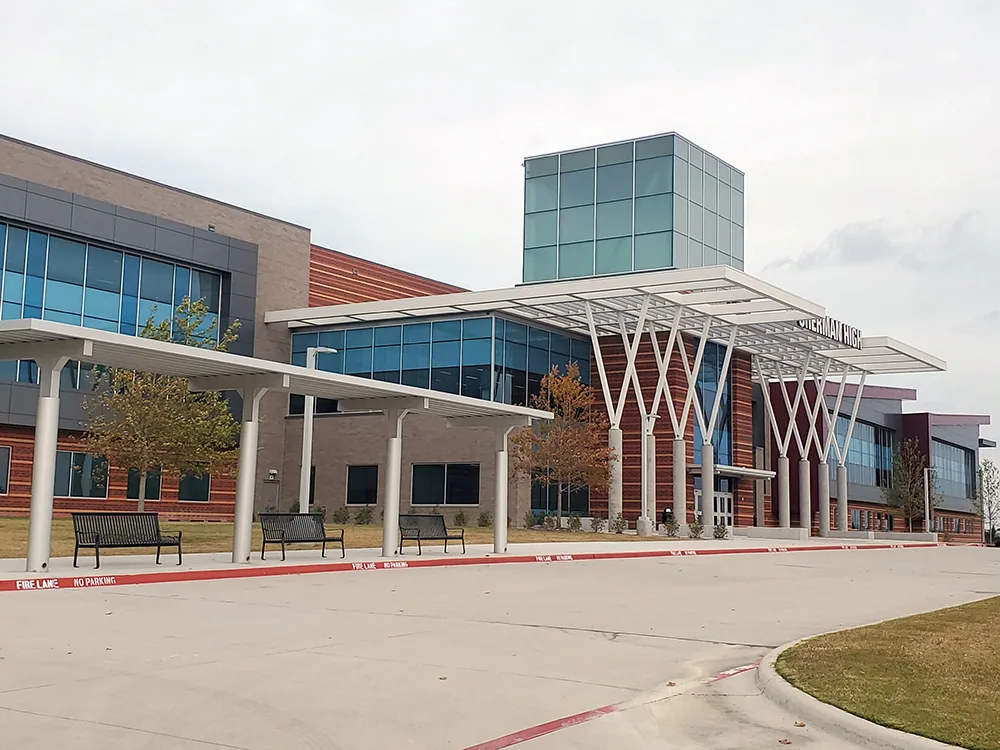
What does a school roof carry besides classrooms?
A school is rarely one roof. A flat low-slope section covers the classroom wing, a taller roof spans the gym, and a mechanical room curb or two interrupts the field. Each area drains differently, and each is exposed to a different slice of the weather. A gym roof with a long span can collect deep drifts, and a cafeteria kitchen exhaust can put heat and grease on one corner.
Snow falls on roughly 54 days of a Bozeman year and totals about 91 inches, while the design ground snow load listed for the city is 50 psf with a 110 mph basic wind speed under ASCE 7-16. Those numbers mean every school roof is also a structure under real load, and it is worth knowing which wing was framed for it.
What does a Gallatin Valley winter do to a school?
December is the snowiest month, at about 16.2 inches, and a January night averages 15.1 degrees F at the low. The pattern a superintendent learns to read is the thaw cycle: sun on a south-facing roof melts the snow, meltwater runs to a drain, and the drain, still in shade, is frozen. Water backs up behind the sump and finds its way under the flashing at the wall.
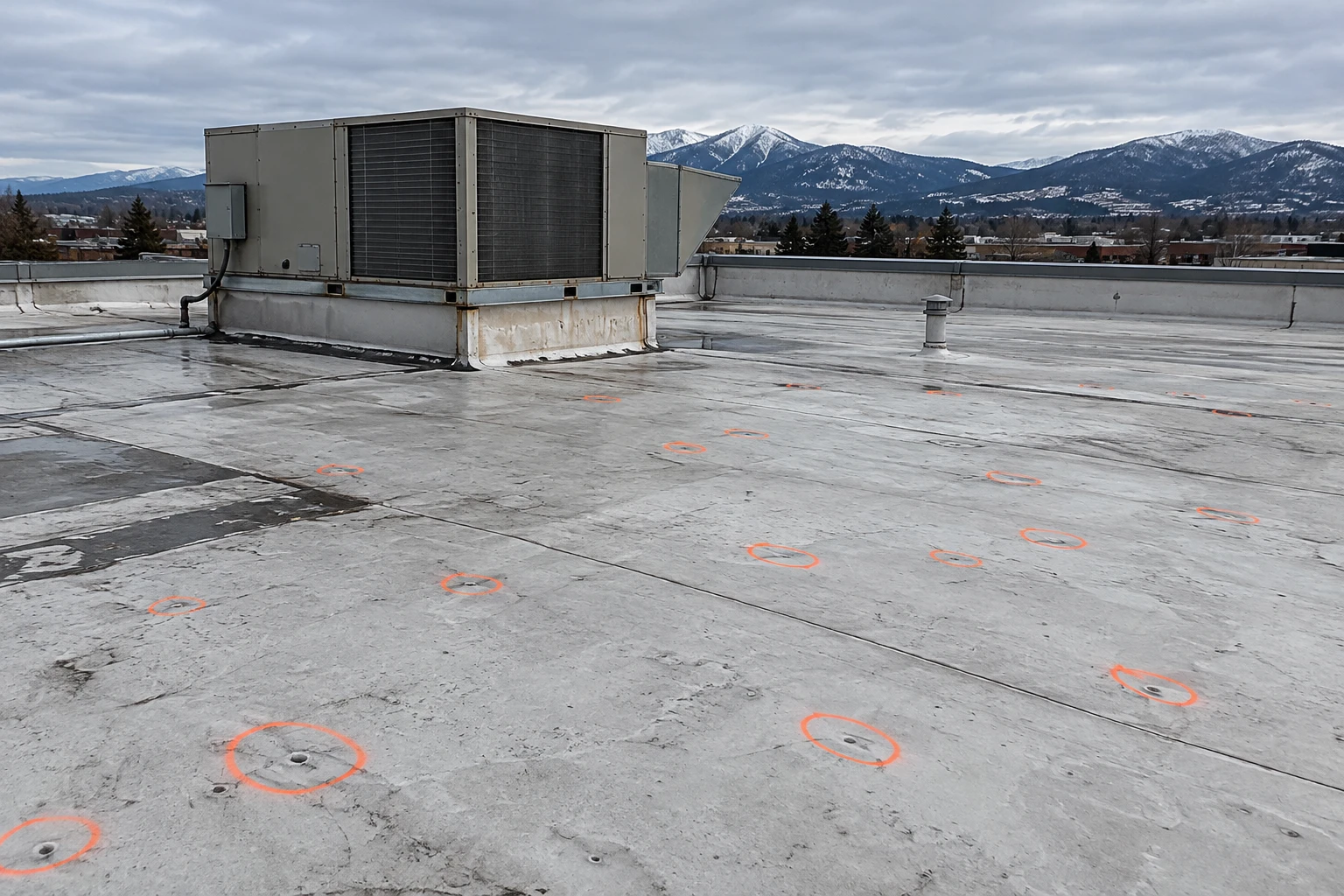
Inside, the first sign is a stain over a corridor or a locker room, usually a few days after a warm afternoon. By then the water has already moved through the insulation. I look for that wet insulation with a moisture meter, and on larger roofs with an infrared scan at dusk. The stain tells me where to start looking, not where the leak is.
Why do hail and wind matter to a school roof?
Half an hour of golf-ball hail on June 30, 2010 cost Montana State University dozens of windows. Large hail came again in early August 2013 over much of Belgrade and north Bozeman, with gusts as high as 89 mph. Those storms are a reminder that a school roof can be bruised in minutes and show nothing from the ground.
After a storm like that, we walk the field and mark every hail bruise with a scale reference and a photograph. A bruise that reaches the reinforcement or the insulation is damage. A dent in the surface is cosmetic. The distinction goes in the report so the district can take it to its insurer with evidence in hand. The repair scope for hail damage roof repair follows from that record, and so does the edge work that follows a gust, since a loose coping cap or a lifted corner is checked in the same walk.
How do you reroof a building full of students?
Mostly you do not, until the students leave. Summer reroofing is the standard. Parents notice a fenced-off lot and a crane before they notice a new roof, so a short letter from the principal explaining the dates, the hours and the detour answers most questions before they are asked. A typical sequence is survey in autumn, bid in winter, order material in spring and tear off the day after the last bell. The crane pick is planned for a morning when the bus lot is empty, and the staging area sits on a corner of the parking lot fenced off from the play area.
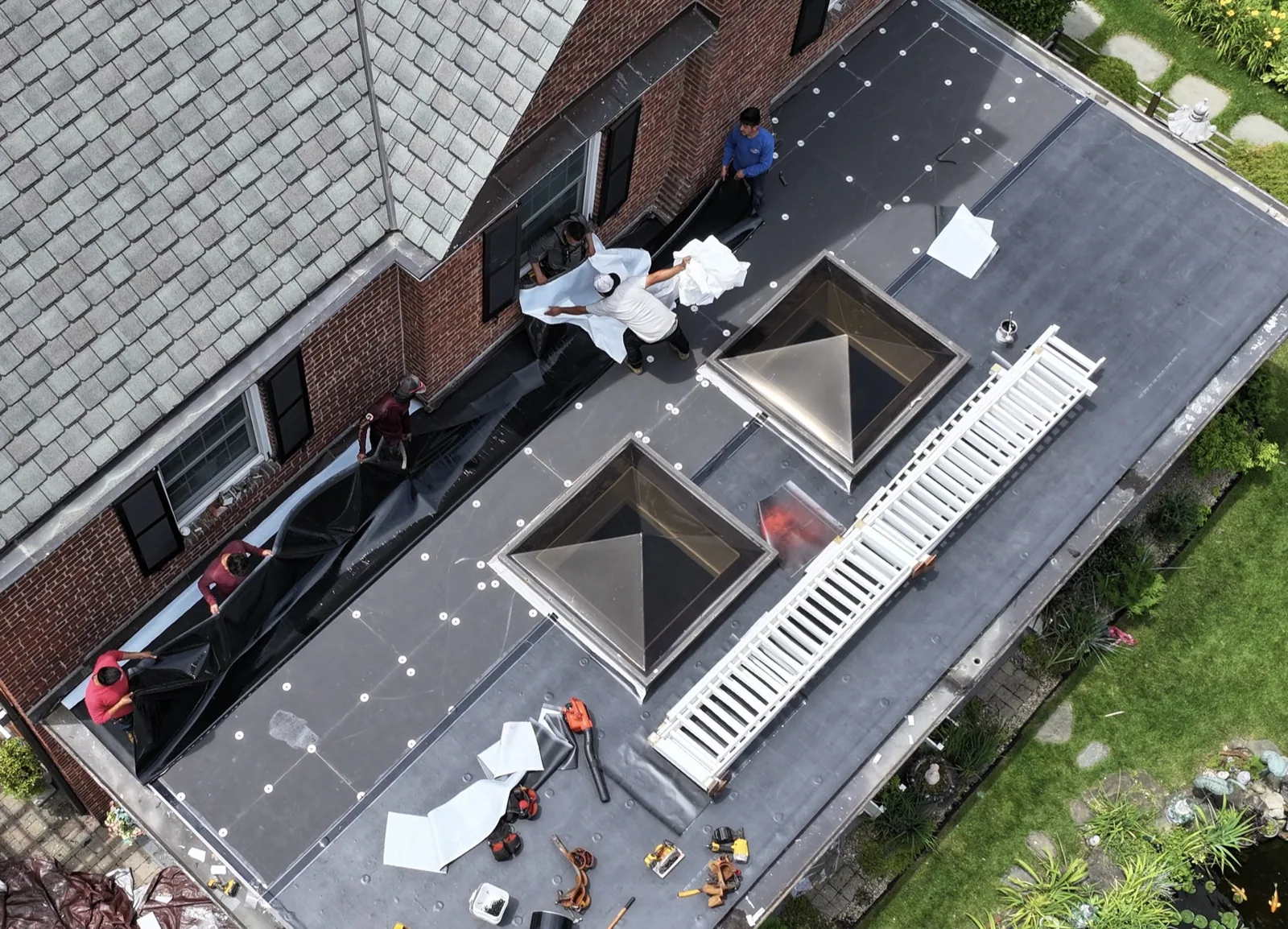
Where a leak cannot wait for June, a temporary dry-in and a repair at the source hold the roof through the term. During any work near occupied rooms, noise and dust control come first. The plan for occupied building reroofing includes phased tear-off, protected entrances and a daily summary for the principal.
Which roof system suits a school?
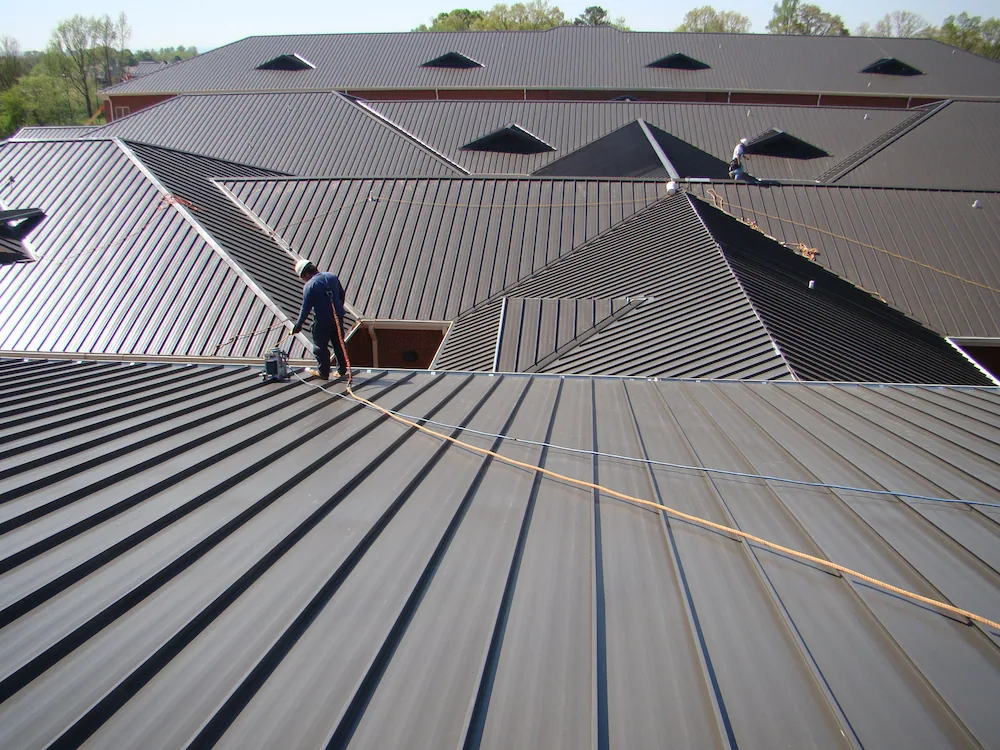
For large low-slope sections, a white single-ply sheet such as TPO roofing or PVC is common because the seams weld and the surface reflects heat. For a roof with heavy foot traffic from maintenance crews, a thicker membrane or walkway pads reduce wear. For a steeper gym roof, standing seam metal roofing sheds snow, though it needs snow guards over every exit.
Insulation and cover board matter just as much. A district that wants lower heating costs can specify more insulation during the replacement, and a cover board protects the membrane from hail and foot traffic. The choice goes in writing with the installed cost and the work window each option needs. If the district is also considering rooftop solar later, the layout of curbs and walkways is set now so panels can be added without cutting new penetrations through a young membrane.
How should a district decide between repair and replacement?
The core cut answers most of it. We take small samples from the roof, check the layers and test for moisture. Where the insulation is dry and the membrane holds up under the surface wear, a repair or a coating can carry the roof for several more seasons. If wet insulation runs across much of the roof, replacement saves money over time.
Districts with several buildings benefit from a ranked list across all the roofs, which shows what to fund first. The list carries each roof's age, drain count, last repair and a color grade, so a board member can read it in five minutes. We update it after every storm season, and a roof that moves from yellow to red gets pulled forward in the plan. A roof condition report can feed a multi-year budget for any of the school districts in the valley. That ranking covers buildings from Belgrade to Four Corners, it suits a nearby college campus as well, and a standalone gym is checked the way a fitness center roof is.



Questions About School Roofing
A custodian reports water on the gym floor after every thaw. Where do we start?
Start with the drains and the wall flashing on the gym roof. Drifts melt, the sump freezes and water backs up under the termination. We clear and test the drain path, inspect the flashing and probe the insulation nearby. If the insulation is wet, we cut it out and replace it in the same visit.
Can a roof replacement fit inside a summer break?
Usually, for a single wing or a modest building, if material is ordered in spring and the crane date is fixed early. Large campuses are phased over two summers. The schedule names which wing is open and which entrance is closed each week.
How do we show an insurer that hail damaged our roof and not age?
Photographs with scale references, a roof diagram marking each bruise and moisture readings beneath them. Random impact marks in a scatter pattern point to hail, while uniform wear points to age. We assemble the file and leave the coverage decision to the carrier.
Do snow guards belong over school entrances?
Yes, where a metal or steeply sloped roof drops snow toward a door or walkway. Guards break a sliding sheet into small pieces that melt gradually, and their layout depends on pitch, panel profile and snow depth. A low-slope membrane roof does not usually need them.