
Senior Living Roofing in Bozeman, MT
Senior Living Roofing in Bozeman and the Gallatin Valley
A senior living building has a different kind of quiet than a warehouse or a store. Residents are home at every hour, aides walk the corridors overnight, and a damp ceiling tile above a resident room is a care problem long before it is a maintenance item. After a Gallatin Valley winter, the roof over that kind of building tends to show the same signs. There is a ridge of ice at the eave above the covered entry, a drift packed against the parapet where a low wing meets a taller block, and a stain in a corridor ceiling that traces back to a mechanical room curb.
Roughly 91 inches of snow fall on Bozeman each year, and the thaw cycles push that water at every weak detail. Which wing of your building has had a ceiling stain, and was it in a resident room or a corridor? That answer tells me where the first core cut goes.

What does a senior living roof look like from above?
Most of these buildings are not one clean rectangle. They are wings joined at angles, with a taller dining or common block in the middle, courtyards cut into the plan, and covered entries where families and transport vans pull up. That plan produces a long list of roof intersections: low roof against high wall, canopy against facade, courtyard parapet against a walk. Every intersection is a flashing detail, and flashing is where a roof gives out first.
Then come the penetrations. A care building exhausts a lot of air through kitchen hoods, laundry vents and bathroom stacks, and each one is a curb or a boot that must stay sealed through repeated expansion and contraction. When I walk one of these roofs, I count penetrations before I look at anything else. The field is usually a low-slope single-ply such as TPO, sometimes over tapered insulation that sends water toward interior drains.
What does a Gallatin Valley winter do to a care building?
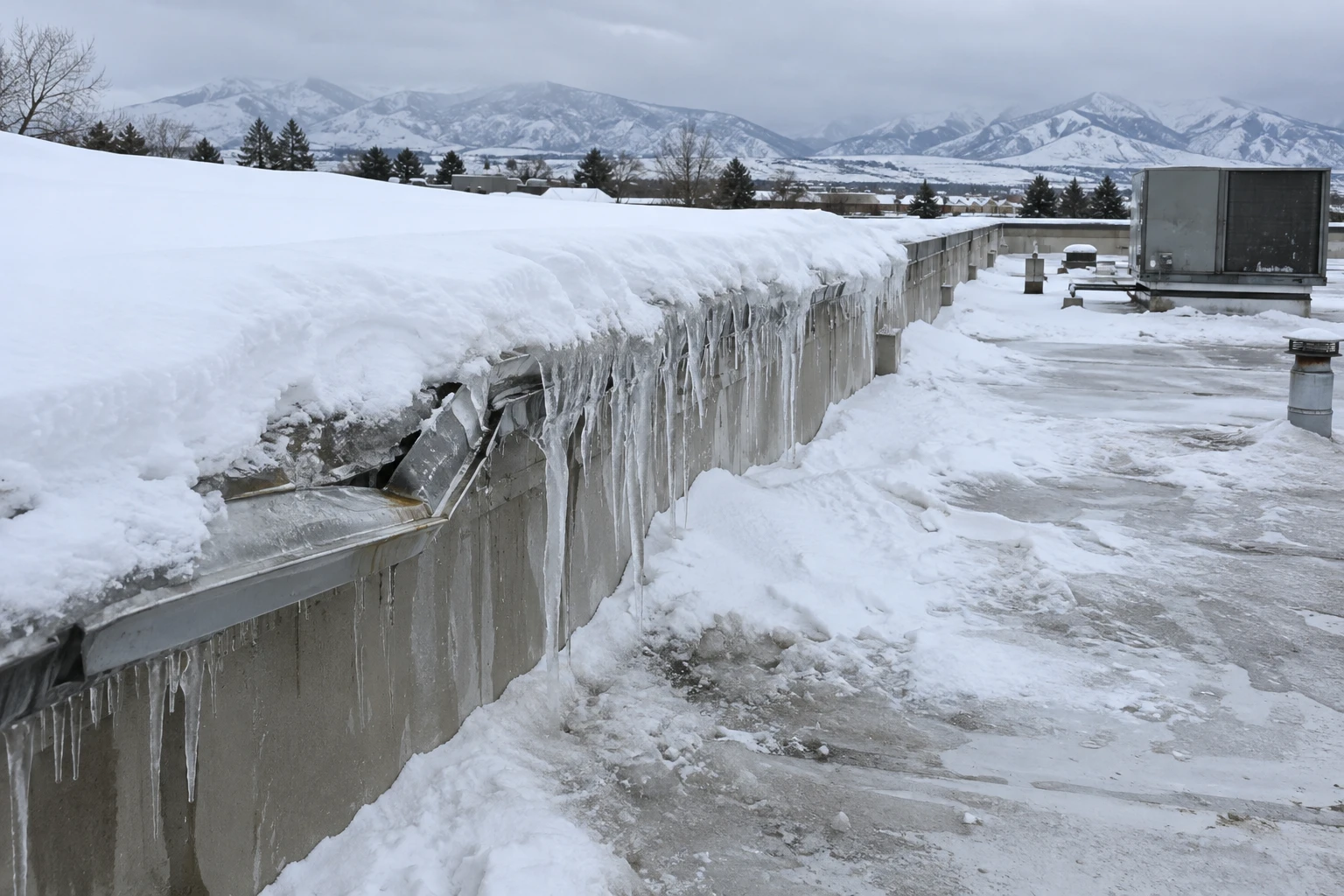
A roof here sees roughly 54 snowy days a year, January lows of about 15 degrees F and a record of minus 46. A roof here does not simply get cold, it swings. A sunny afternoon melts the surface of a drift, the water runs to the nearest low point, and the next night freezes it solid. By late February the roof has been through a dozen small freeze cycles.
On a senior living roof the damage concentrates in three places. The covered entry collects ice at the eave, a slip hazard below and a water source behind the fascia. Valleys between wings hold drifts for weeks and keep seams wet. Courtyard drains, sheltered from the sun, are the last to thaw and the first to back up. Designers work from the 50 psf ground snow figure in the 2021 IBC, and a pond behind a blocked drain adds weight on top of the snow. Our snow and ice damage repair work starts at exactly those spots.
Where do leaks start when the building is full?
The first suspects are the penetrations and the wall terminations. A rubber boot on a vent stack cracks in the cold and lets meltwater track down the pipe. A counterflashing that has pulled away from the brick leaves a gap where wind-driven snow blows in. None of these show up as a puddle at first. They show up as a slow stain, a swollen baseboard or a ceiling tile that sags a little more each week.
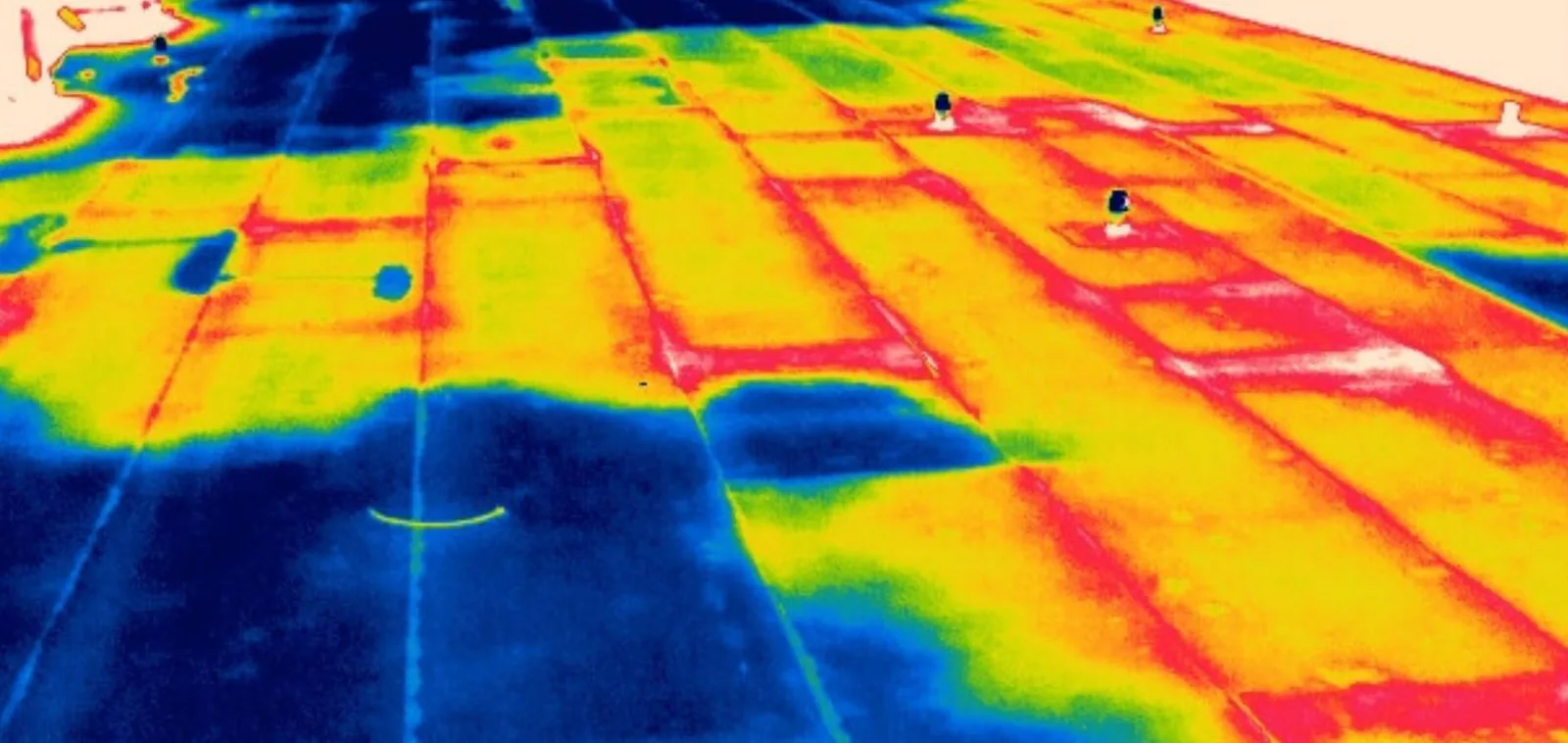
Moisture hides in the insulation too. Wet polyiso under a dry-looking membrane keeps its water for years. We scan on a cool evening, when the roof gives up stored heat unevenly, and our infrared moisture survey maps the wet zones before anyone cuts. In a care setting that map matters: if only one wing is wet, only one wing is disturbed, and the rest of the building stays quiet.
How do you reroof over people who live there?
Residents are the schedule. We plan around meals, rest periods, therapy visits and medical transport at the main entry. Staging goes on the side farthest from resident windows and the pickup lane, material is hoisted rather than carried through occupied space, and loud work such as tear-off gets the hours that disturb the fewest people.
Air is the other concern. Hot asphalt, strong solvents and some adhesives send odor into fresh air intakes. We locate every intake before the job starts and choose systems that keep odor low, with a tear-off sequence that never leaves a wing open overnight. Where a full replacement is not needed, a roof recover avoids the debris and noise of complete tear-off. Our approach to occupied building reroofing applies here, tightened further: one wing at a time, dry-in every day, and a named contact for the charge nurse.
What do hail and wind add to the picture?
Winter is the steady stress, but the valley has taken real hail. Golf-ball stones hit Bozeman on June 30, 2010 and lasted about half an hour, and in August 2013 they blanketed much of Belgrade and north Bozeman while gusts reached 89 mph. Montana criteria for Bozeman list a 110 mph basic wind speed, so a loosely installed roof edge can lift well before it reaches that number.
Hail leaves bruises, small fractures in the membrane or crushed insulation that feel soft underfoot. A bruise that does not leak in July can leak in January, so I walk the whole field after any storm report. Dated photos from that walk support an insurance claim conversation. A building in Churchill, where a retirement home is among the larger buildings, gets the same post-storm walk.
Should the owner repair, restore or replace?
The roof tells me, and the capital plan tells me how fast. A membrane with sound seams and dry insulation is a candidate for repair and a maintenance plan. A membrane that is sound on top but wet below needs a partial tear-off at the wet areas. A roof with failing seams across the field and a record of ceiling stains is at the point where more patches cost more than a new system.
A written report with photos gives a board or lender something concrete. Our commercial roof inspection produces it, and preventive maintenance keeps drains clear and sealants fresh between replacement dates. Residents cannot leave for a few days, so replacement goes in the dry months. Clinic and hospital owners work under the same constraints, and a hospital roof or a medical office roof gets the same phasing.



Questions About Senior Living Roofing
A resident reported a stain over a bathroom. Is that the roof or the plumbing?
Look at the timing. A stain that grows after a thaw and stays dry in between points to the roof, usually a vent boot or exhaust curb nearby. A stain that grows regardless of weather points to a supply or drain line. We trace the roof side with a moisture meter and, if the roof is clean, we say so.
Can the building stay open while the roof comes off one wing at a time?
Yes, and that is the normal sequence. Each wing is opened, dried in and sealed the same day. We find every fresh-air intake first, keep the pickup lane clear, and give the administrator one site contact who can stop noisy work if a resident needs rest.
How do we tell whether old hail damaged our roof?
Walk the field and the metal. Dented coping, dimpled unit housings and soft spots in the membrane all point to impact. The 2010 and 2013 storms struck different parts of the valley, so the building's location matters. We photograph and mark what we find.
Would snow guards or heat cable help above an entry canopy?
Often both. Sliding snow from a high roof can land on a canopy or a walk, and a few rows of snow guards release it in small amounts. Heat cable at the eave and downspout holds a path open for meltwater and stops the ridge of ice.